Category Archives: Whatever-happened-to?

German Economy Reigns 25 Years After Unification

Share

By: Laurene Jardin

2436847892_6e6387f216_o
A memorial has now been set up for those who died during the establishment of the Iron Curtain. This year will mark the 25th anniversary of German reunification. Picture © Doug McGr on Flickr.

A corrupt empire, high inflation rates, and the general devastation of war slapped the German economy in the 20th century. Today the country is not only known for its cold beer, fast cars and lively festivities, but for being a keynote player in the capitalist world.

This was not the case 25 years ago before the annexation of the Communist German Democratic Republic located in East Germany and the Federal Republic in the West.

“You walked into a store and there would be a toaster. And then about a foot away on the same shelf you would see an old book. And beside that you’d have one pair of women’s shoes in a single size,” Grace Byrne said speaking of her experience in East Germany in the late 80s.

Byrne, an assistant reporter at NBC in Frankfurt and was sent to Berlin to cover the reunification story. She revisited Berlin a few weeks after the dust settled.

Byrne compared the merchant filled streets of post-unification Berlin to Disneyland.

“Everything was for sale. People were breaking up parts of the sidewalk and trying to sell it to us. I mean, geez, to think that Easterners had known nothing about the capitalist world and were thrown into it like this was fascinating,” she said.

Germany not only embraced capitalism; they honed it.

According to the World Bank, Germany currently has the fourth largest Gross Domestic Product, GDP, in the world. Its economy has grown steadily since the 1970s.


source: tradingeconomics.com

Germany also have the largest economy in Europe and hold seats on prominent committees such as the European Union, the G8 and the United Nations’ Security Council.

Axel Huelsemeyer, an expert of international economy and a political science professor at Concordia University, was one of the first Westerners in the social science program at Potsdam University, in Eastern Germany.

He has witnessed and studied Germany’s growth over the years.

This year the country implemented a minimum wage of €8.50 euros per hour, which works out to be about $11.70 Canadian dollars.

Huelsemeyer said that the country is doing well on an international scale both economically and politically.  It has been able to lend money to indebted countries like Greece and is involved in organizing peace negotiations between nations like Ukraine and Russia.

Domestically Germany has a few weaknesses.

A recent report by Germany’s Equal Welfare Organization said poverty and wage disparity has not been this high since reunification.

According to the study 12.5 million people live in poverty. Most affected are the cities of Bremen, Berlin and Mecklenburg –Vorpommern.

Peter Finger, Legal and Cultural Counsellor of the German embassy to Canada from 2008 to 2014, was a diplomat for Western Germany in the late 80s and early 90s. Finger helped house refugees who had made it across the Eastern soldiers, negotiated with the German Democratic Republic to free Western prisoners.

“You could tell the difference between a Westerner and an Easterner by their clothes. The West was Americanized. Their clothes were grey,” Finger said.
Thefalloftheberlinwall1989
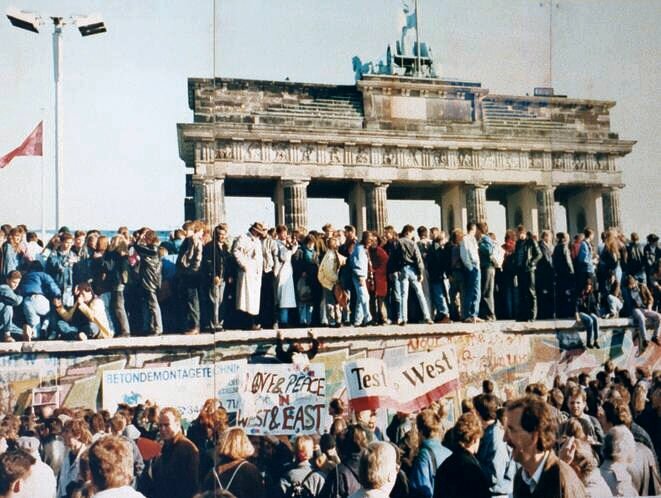
Germans stand at the Brandenburg Gate in Berlin. One year later the East and West unified to become an early version of what Germany is today. Photo © Lear 21 at en.wikipedia.

While there is still a wealth gap between East and West Germany according to Huelsemeyer this is not more than would be expected.

“There is a transfer of goods from one part of the country to another. It’s like in Canada. The West transfers its goods to the East. It’s not an even split of resources.” Huelsemeyer said.

He also explained that Western companies quickly bought out Eastern companies to avoid competition.

In 1990, the federal government instilled a national solidarity tax of 5.5 per cent to help fund the East. In 2009 the tax was brought to court for being unconstitutional, overridden by a higher court in 2010.

Still, Huelsemeyer says that all things considered, Germany has come a long way.

“Where could they improve? I guess they could be more sensitive to the sensitivities of others,” Huelsemeyer said.

“But in terms of economy they are doing a good job.”


____________

Documentation:

Press Release by Germany’s Equal Welfare Organization “Armut auf Höchststand: Studie belegt sprunghaften Armutsanstieg in Deutschland Kategorie: Pressemeldung.” Study found on the internet. Recommended by an interviewee. Translated with help of Nicole Rutherford.

Study “Armut auf Höchststand: Studie belegt sprunghaften Armutsanstieg in Deutschland Kategorie: Pressemeldung. ” Found on the internet. Found study name through website that press release was released on. Very useful and up to date information that could be easily attributed to an organization.

After Oka, strengthened aboriginal communities are fighting harder for land rights

Share

A quarter-century since an armed standoff between Mohawks and the military in Oka, Que. drew widespread attention in Canada and beyond, Aboriginal activists have been galvanized in their fight for land rights.

The Oka Crisis unfolded over the summer of 1990, on the shores of the Lake of Two Mountains, 45 minutes from Montreal. Mohawk from the Kanesatake community opposed a golf course expansion and proposal for luxury condominiums on land they claimed. On July 11, Oka mayor Jean Ouellette sent in Quebec’s provincial police, leading to a soldier’s death. It culminated in a 78-day standoff between the army and the Mohawk, while Mohawk from nearby Kahnawake barricaded the Mercier Bridge, a key route into Montreal.

Albert Nerenberg, then a Montreal Gazette journalist, sneaked behind the barricades and army razor wire to document the crisis from the Mohawk side. “Prior to the Oka Crisis, there was a feeling that aboriginal people were in continual decline,” he said.

But according to Nerenberg, who keeps in contact with many Mohawk he met during the crisis, this was a turning point. “It highlighted that a lot of Canadian infrastructure passes through native lands,” he said. “It caused Canada to take native people a lot more seriously.”


For CBC journalist Loreen Pindera, who wrote a book on Oka, the magnitude of the crisis led to both stronger aboriginal activism and greater respect for land rights. “We sent more Canadian soldiers to surround those two Mohawk communities than we sent to the first Iraq war,” she said, noting that it was an event that the government did not want repeated.

According to Pindera, since Oka, aboriginal communities are succeeding more at staking their claims in land rights discussions. “The approach is ‘maybe we’ll say yes to cutting down trees or yes to a pipeline, but it’s going to be on our terms’,” she said. “That’s loud and clear now.”

Pindera points to thwarted attempts to mine Niobium, a metal used for engines, near Oka. “It’s been stalled by both environmental opposition but also Mohawk opposition saying it’s not going to happen without our go-ahead,” she said.

The successful non-violent blocking of this mining marks  a change from 1990, when the Oka community tried to force through developments with minimal Mohawk consultation.

This more robust activism combined with newfound respect for aboriginal land claims may have helped stave off a repeat of the Oka Crisis. Duncan McCue, a journalism professor at the University of British Columbia specializing in indigenous reporting, says that taking aboriginal voices seriously is key to avoiding violent disputes.

“So many of these conflicts get headed off and resolved before they get to the boiling point because first nations people are flexing their muscles politically,” he said.

In British Columbia, members of the Seton Lake Indian Band blockade a rail line in solidarity with Mohawk in the Oka Crisis.

But strengthened aboriginal voices stemming from Oka haven’t necessarily meant that aboriginal communities’ rights are always respected. Pindera noted that none of the Mohawk demands from the crisis were ever met.

According to Pierre Trudel, a political science professor at UQAM in Montreal, aboriginal rights are still in conflict with the rights of private property owners.

“The federal government refuses to expropriate private property for land claims,” he said. Instead, the government offers aboriginal communities money or some other land, said Trudel.

“Canadians must decide to voluntarily sell their land to meet land claims,” he said. “It’s a continuing policy in Canada.”

Yet despite continued legal dilemmas, McCue said aboriginal activists are succeeding, if gradually. “Our people are becoming more and more vocal on a bunch of different fronts,” he said. “And I would argue that self-governance is becoming more and more of a reality.”

So while the rights of the Kanesatake Mohawk may not have been met at Oka, the progress since the crisis means that the barricades and standoffs were not in vain.

Documents:

La crise d’Oka de 1990: Retour sur les événements du 11 juillet

This is an article written by Pierre Trudel for the academic journal Recherches Amérindiennes au Québec in 2009 detailing the claims and developments that led to the firefight on July 11, 1990, and precisely detailing the events of that day. It was sent to me by Pierre Trudel after my interview with him. It was useful because it provided a precise, accurate detailing of the background to Oka, especially regarding land claims, in a far more detailed way than most simple recounts of the crisis found online. Because Professor Trudel was my first interview, the precise detail of this article helped me develop good specific questions for my later interviews (two of who were with people present at the crisis).

People of the Pines Chapter 9: Food Smugglers and Gun Runners

This is a chapter from a book detailing the Oka Crisis called People of the Pines, by Geoffrey York and Loreen Pindera. I found out about the book via online search engines and this was the only partial copy of the text I could get at short notice, also found via strategic use of Google (note that it is stored on the Université de Montréal‘s website as I don’t have the rights to reproduce it). It was useful partly for background information but more importantly, it gave me a large list of names of people directly involved in the crisis to attempt to contact. Most were uncontactable or didn’t get back to me, but it led me to the author herself, Loreen Pindera.


Twenty-five years later, GST has increased competition for manufacturers, but experts and industry say more tax incentives needed

Share

By: Hayley Chazan

Twenty-five years after Brian Mulroney’s government implemented the Goods and Services Tax (GST), economists and politicians agree that the tax – long abhorred by consumers – has achieved its intended outcome of increasing competition for Canadian manufacturers.

But tax experts and industry say that the GST is only one factor that affects competitiveness.  They say that in today’s globalized market, other tax incentives for Canadian manufacturers should be implemented in order to encourage investment.

In the 1990s, the government undertook major tax reform to replace a 13.5 per cent Manufacturers’ Sales Tax (MST) with the GST.

The MST was a tax placed on manufactured goods produced in Canada.  Manufacturing companies incurred the tax each time they purchased machinery.  This drove up prices and placed Canadian manufacturing exporters at a competitive disadvantage.

The GST intended to remedy this by taxing consumers directly.  Any tax incurred elsewhere in the production chain would be recoverable through tax credits.

But the GST became a political nightmare, mostly because it was so noticeable to the taxpayer.

“We tried to do ads showing that many products would be cheaper under the GST,” said Senator Marjory LeBreton, Mulroney’s deputy chief of staff at the time.  “But all Canadians could understand was that they would have to pay seven more cents on every dollar.”

Because Mulroney had a majority government, the GST quickly passed in the House of Commons.  But the Liberal-dominated Senate, refused to pass the tax into law.

Using a rare tactic that required special permission from the Queen, Mulroney appointed eight additional senators, giving the Conservatives a loose majority in the upper chamber.  The GST passed on Dec. 13, 1990, by a vote of 55-49 after an 11-week filibuster.


CBC Digital Archives

“The biggest challenge for the Liberal Senate caucus was finding ways to make a filibuster work,” longtime Liberal Senator Colin Kenny recalled.  “At one point, Senator Hastings collapsed in the middle of his speech.  It was very dramatic.”

Despite Liberal opposition, Kenny now acknowledges that the GST is smart policy.  Consumption taxes accounted for 11.4 per cent or $31 billion worth of government revenue in the 2013-2014 federal budget.  Kenny said that this revenue source provides stability to government in bad times.

In 2008, the Harper government lowered the GST from seven per cent to five per cent.  At the time, Brian Mulroney called the tax cut “good politics, but bad policy” because it cost the government nearly $14 billion in revenue.

Twenty-five years later, experts like Carleton economics professor Frances Woolley and Montreal tax expert Martin Gilbert agree that Canadian manufacturing exports are more competitive than they would have been without the GST.

Industry groups also applaud the GST.

“Value added taxes, in general, allow Canadian manufacturing companies to invest in machinery without the burden of taxation,” said Mike Holden, director of policy and economics at Canadian Manufacturers and Exporters (CME).

But Woolley questioned whether or not the switch to the GST has been enough to allow Canadian manufacturers to compete successfully in a globalized market.

“The GST is just one factor of Canadian competitiveness,” said Gilbert.  “If tax authorities from other countries decide to offer incentives to boost their respective economies, there might not be much Canadians can do.”

Holden said that progress is needed to ensure that the Canadian manufacturing industry remains competitive.  The CME said that compared to the US, Canadian manufacturing companies are too small to invest in new facilities and equipment that is critical to their long-term success.

A tax incentive Holden said could help encourage investment is the Scientific Research & Experimental Development (SR&ED) credit.  The SR&ED provides a tax break to small manufacturers for eligible research and development completed in Canada, but Holden said the SR&ED has been cut in recent years.

“The tax system has the potential to play a strong role in encouraging investment in the Canadian manufacturing industry,” Holden said.

Documentation:

1990: Mulroney stacks Senate to pass the GST

This is a CBC news package with Peter Mansbridge from 1990 that aired the day the Queen granted the Mulroney government permission to appoint eight additional senators.  I found it online using CBC’s digital archive.  This was the first source I consulted when trying to decide on a topic.  The video was helpful because it gave me a good sense of the chain of events that unfolded on the day the GST was passed.  It provided a good explanation of the opposing viewpoints of both the Mulroney government and the Liberal senators.

Partial transcript from interview with Senator Marjory LeBreton

This is a partial transcript from a 13-minute interview I conducted over the phone with Senator Marjory LeBreton on Feb. 24, 2015.  I was able to arrange the interview by sending an e-mail to Senator Lebreton’s administrative assistant, Louise Haddock on Feb. 12, 2015.  I obtained Ms. Haddock’s contact information on the Parliament of Canada website.  When I started my research, I found it difficult to understand why Canadians were so reluctant to accept the GST, especially since it made good economic sense and would save them money.  This partial transcript addressed this issue.  It provided me with a clearer understanding of why Canadians couldn’t wrap their heads around the benefits of the GST.

Haitians still waiting for promises of a better life to be fulfilled

Share
Aristide Picture
Jean-Bertrand Aristide in Haiti in 2011. Photo Credit: Google Creative Commons

Twenty-five years after its first democratic elections in decades, Haiti has become poorer, more fractured and less trusting of the outside world.

There have been coup d’états, economic restructuring and earthquakes, all of which have crippled the country’s ability to sustain consistent economic growth. But the biggest impact has been the loss of hope for the future.

On December 16, 1990, a Catholic priest named Jean-Betrand Aristide became the president of Haiti. He was voted into power with over 50 per cent of the vote, ending years of rule under dictatorships that had alienated and impoverished most Haitians.
Aristide campaigned as a spokesperson for the marginalized and poor. He promised them a better life.

“There was a lot of excitement and a huge sense of hope,” said Marylynn Steckley, who lived and worked in Haiti as a food policy analyst in 2007, and then returned for two years after the devastating earthquake in 2010.

“He was put on a pedestal as someone who would help people, lessen the divide between rich and poor and make their lives better. That is gone now”

Despite the hope that fueled his rise to power, Aristide’s government did not fulfill its promises. Over the next 15 years he was exiled twice, overthrown by the military, and placed the country on an economic path that crippled its development.

“The popular movement lost its momentum,” says Ron Blunschli, who was an activist during the Aristide’s first presidency, and has seen the public sentiment in the country change over the last 25 years.

“By the end of the 90s, the mood was very depressing. People lost faith. People have lost faith”

This loss of faith has been reinforced by the fact that Haiti no longer receives the attention that it did at the time of the elections or the military takeovers. Haitians believe that the world has moved on without them.

“The light was on this country before, but it’s gone now,” says Blunschli.

Haitians are struggling to survive in a global economic system that punishes island states with chronic under-development and weak leadership.

“The liberal policy being imposed on Haiti is strangling it,” says Blunschli.

Developing countries like Haiti depend heavily on aid from other countries to provide essential services and maintain infrastructure. However, to receive this aid, governments are required to liberalize their economies, making it easier for foreign companies to do business there. The hope is that the process will bring money, stability and provide the foundation for a stable economy.

The reality is that countries need strong, accountable governments for economic reforms to be effective. It is a quality Haiti has lacked for decades.

“They knew the structural adjustment programs weren’t going to work in Haiti,” saiys Blunschli.

Haitians are still poor despite these restructuring efforts, and they have become increasingly distrustful both of their own governments and international governments that are trying to help them.

These feelings were reinforced after the devastating earthquake in 2010 which killed more than 200,000 people. The underdeveloped infrastructure was ill-equipped to recover from the damage the earthquake cause, and the international aid and support that was supposed to help Haiti recover never made its way there.

Haitians have become increasingly cynical towards the outside world as a result.

“Before, the cynicism was focussed inwards,” says Blunschli. “There was a general recognition that the culture and history had put them in a particular position. Since the earthquake they believe that NGO’s in all forms are a bunch of thieves.”

Documentation:
Haiti’s Leftist Priest-President Faces Economic Quagmire

This is a Reuters article published days after Aristide was first elected into government. I obtained it from Factiva. It gave me a good sense of the mood of the country right after Aristide won the election in 1991. There was optimism and hope in the country, but there was also wariness from the outside world at a leader who won on such a populist platform.

5 Years later; Impoverished nation still on shaky ground; Rebuilding strides have been made, but thousands call tent cities home

This is a recent USA today article about the state of Haiti following the earthquake and efforts to rebuild. This was also obtained through a Factiva search. It helped me to get a sense of what have been happening since the media attention on the earthquake moved elsewhere. It was useful because it discussed the challenges that still have to be overcome despite the money donated.

South Africans still have a long walk to freedom: 25 years after Mandela’s release

Share
PHOTO CREDIT: Cory Doctorow // Nelson Mandela shirt, Yorkdale, Toronto, ON, Canada

By Evelyn Harford

Nelson Mandela, a black South African anti-apartheid activist, was released from prison 25 years ago. Crowds gathered to watch Mandela’s walk to freedom from the Cape Town prison where he was held.

Mandela’s freedom marked a symbolic movement away from racism and inequality that was institutionalized in South Africa by the near 30 decades of apartheid.

Denzil Feinberg, a white Cape Town native remembers the day well. Feinberg watched Mandela walk through the streets of Cape Town as a free man.

“There was great elation,” he said.

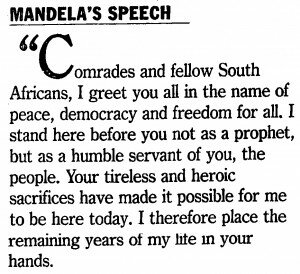
Mandela addressed the world in a speech immediately after release. In it, Mandela preached the end of apartheid and looked ahead to a free, equal and democratic South Africa.

Feinberg listen closely to the message.

Mandela’s transcribed speech appeared in the Washington Post on Feb. 12, 1990.

“I thought finally, we got a change,” he said. “And because he was so respected there wasn’t a fear of anything going wrong. We thought that South Africans would just make it work.”

Mandela was imprisoned for 27 years for his resistance against the apartheid government of South Africa. His release marked a significant shift in hope for the black population of South Africa.

Kuhle Mthembu, a black South African was only eight-years-old at the time of his release.

“I knew that his release was a massive moment,” said Mthembu.

“It was all over the news, all over the papers, and there was an air about the country. One of hope and fear,” she said.

“Black people were hopeful that finally they could live like and be treated as humans in their own home, and white people were fearful that black folk would want to retaliate and possibly a civil war would break out. ”

Instead of violence, Mandela tried to rally the nation into peace, reconciliation and trust. A fair and free election was held four years after Mandela’s release in which, Mandela became the first black President of South Africa.

However, Mandela’s vision of peace, tolerance and reconciliation have been met with disappointment since his release in 1990.

“People invested in Mandela at a symbolic level and their expectations were over the moon,” explained Chris Brown, a professor of South African politics at Carleton University.

“There are these huge expectations, combined with a real lack of knowledge of what he believed and what he would do,” said Brown.

The high expectation of Mandela’s power and vision for reconciliation in South Africa caused part of the disappointment in South Africa.

Feinberg said that in South Africa today, “There is more violence and fear than ever before.”

Feinberg now, 71 lives in Canada; he is Treasurer of the South African Rainbow Nation Association in Ottawa. He says although he will visit his home country he would never live in South Africa again.

The increase in violence is largely equated with economic inequality. Mandela wanted to reduce the large gaps between the rich white population and the poor black population.

“You have not seen the transformation of economic inequality between the black elite and the poor. The white population remains well off for the most part and the black pop remains in the same place that they were,” said Brown.

“Economics is the biggest issue in this country,” agreed Mthembu. “Race is not number one. Simple economics. Race is no more an issue here than it is in most other countries.”

Mandela’s legacy of peace, equality and reconciliation will never be forgotten. However, Methembu warns however that South Africans need to have realistic expectations of his impact.

“He was not God,” said Mthembu. “Like all freedom fighters across the ages, he along with his fellow comrades, was a man, with a dream.”

Mthembu does recognize that as a public and political figure, Mandela did change fundamental rights for black South Africans–including the right to vote.

However, Mthembu worries South Africans lean too much on the symbolism that Mandela represents.

Mthembu admitted, “He had not been active for a long time. And South Africans have been hiding behind his dream for long enough.”

Blame on the past will not change the future said Mthembu.

“Until people stop thinking that over 400 years of colonialism can be rectified in two decades, we will keep having problems.”

Documentation:

Mandela’s Speech—Washington Post, Feb. 12, 1990.

1) This document provided the transcribed version of Mandela’s first speech that he made to a crowd in Cape Town, South Africa upon his release from prison.
2a) I obtained this document through the newspaper archive search on Proquest.
2b) This document gave me the background to understand how Mandela’s vision was outlined and indeed eluded to in the speech he addressed South Africa with. It allowed me to chart the expectations Mandela set out for South Africa and analyze how these expectations have been a source of disappointment in South African 25 years later.

Exiles Jubilant, Cautious About Mandela’s Release—Washington Post, Feb. 11, 1990.

1) This document appeared in the Washington Post on the day of Mandela’s release.
2a) I obtained this document through Proquest archive searches.
2b) This document gave the perspective of the South African Diaspora on Mandela’s release. The article brings home the idea that although most South Africans have never personally met Mandela they feel connected to his message and what his symbolized at the time of his release (resistance, freedom and change).

The role of the GST in Canadian economy, 25 years after the controversial tax bill was passed

Share

25 years ago the Conservative dominant House of Commons passed the Goods and Services Tax (GST) bill despite huge opposition from both political rivals and the public. But the GST is now one of the major sources of revenues for the Canadian government.

In the fiscal year 2013-14, the total amount of revenues collected from the GST was 29.9 billion dollars, which constitutes 1.6 per cent of the total gross domestic product (GDP). The amount is projected to have a steady increase in coming years.

Tax consultant and lawyer Amin Miah said, “The government won’t be able to implement its budget without the GST. People don’t like to pay taxes but now Canadians understand that the GST is crucial for running social programs”.

The Progressive Conservative government led by Stephen Harper cut down the seven per cent GST by one point on July 1, 2006, and a further percentage point on Jan. 1, 2008. The measure was welcomed by the public, consumer groups while critics said it benefitted the high income people only.

University of Ottawa Professor Jean Bernard said that lowering the GST was a bad decision. He said, “The GST cut does not make a huge difference for the average income households but imposes certain extra costs on businesses.”

“The revenue losses caused by the reduction in the GST mean cutting back funds for social welfare and development programs”, Bernard added.

The GST is harder for the people to evade, as they have to pay the federal sales tax whenever they buy something.

Former Liberal MP Sheila Copps who fought against the GST during her political career said in an e-mail, “Governments like it because it is impossible to avoid the GST if you purchase consumer goods, as everyone does. It generates revenues that some corporate taxpayers would not otherwise pay”.

Sales tax revenue is more recession-resistant and government-friendly than corporate or personal income tax payments.

In December 1990, after eight months’ debate, amid the cries of protestors in the gallery, members of Parliament voted on the highly controversial Goods and Services Tax bill.

Liberal and NDP members jeered at the Tories and raised protest cards against the proposed seven per cent tax saying it would be hard on lower income Canadians.

On the other hand, the Conservatives defended the tax as a deficit-busting tool and the then Prime Minister Brian Mulroney was adamant to get the bill passed. On its third and last reading, the House of Commons voted to pass the bill 144 to 114, which went into effect on Jan. 1, 1991.

Earlier in September 1990, Mulroney used the little known and highly complicated constitutional provision to stack upper chamber with eight more Tories to evade Liberal opposition to the GST in the Senate.

“At the time, there was already a manufacturers’ sales tax, and the GST was designed to replace that but covered many essentials, including home heating, books etc.,” Copps mentioned.

Copps resigned from the Parliament in 1996 in protest of the Liberal government’s policy of retaining the GST though she was reelected in subsequent by-election.

Prior to the federal election in 1993, the Liberals pledged to eliminate the GST once they were elected.

Documentation:

The History of the GST

The Goods and Services Tax: Overview and History


‘In the North, for the North': after 25 years, UNBC looks to the future

Share

“In the interior…people don’t think of education beyond grade 12. The questions they ask at the end of the day are ‘How many trees did you cut today?’ or ‘How were things down in the mine?’’

That’s what then-minister of advanced education Stan Hagen said in the Globe and Mail in 1989, when asked about the possibility of a university in northern BC.

But almost 25 years after its founding in June 1990, UNBC in Prince George is going strong with more than 4,000 current students. This year it is second in its category in the Maclean’s university rankings. It consistently attracts research funding and even has its own medical school, which specializes in training doctors to practice in the rural north.

Bruce Strachan, who was a member of the legislative assembly at the time of the founding and who became minister of advanced education, presented the petition to found the university to the provincial government.

“I just happened to be the right cabinet minister in the right place at the right time,” says Strachan. “It was a community effort.”

That community included 16,000 residents of northern BC, who each paid five dollars to sign the petition and become founders.

Even with that community support, Strachan says there were many skeptics.

“The ministry didn’t think we could have any interest. But it turned out there were a lot of really first-class academics who wanted to come here,” says Strachan.

Strachan says the university has heavily influenced the intellectual life of Prince George. “You get 450 academics in a town, that will change it,” he says. “We’ve seen a real gentrification in the city.”

Rob Budde, a professor in the English department for the past 14 years, says that the university built on an arts culture that was already there and is now stronger than ever. He says the university has been a home for writers who are uniquely northern.

“The university has contributed a lot to creating a kind of counterculture,” says Budde. “There’s almost a freedom to write up here, whereas in places like Vancouver you’re almost told how to write a certain way.”

Not all UNBC’s programs have been without struggle. Andrea Fredeen was one of the first students in the joint Bachelor of Fine Arts program that was shared with the Emily Carr Institute of Art and Design. She is also one of its last graduates, since it is no longer accepting new students.

Fredeen’s program consisted of creative writing courses offered by UNBC and visual arts instruction from Emily Carr, but as time went on Fredeen says it was harder and harder to get the face-to-face instruction needed for studio art.

Eventually, the partnership with Emily Carr ended when that school got university accreditation itself.

“I have no regrets at all and I think the degree had so much potential,” says Fredeen, who is now doing a master’s in creative writing at UNBC. “I think it just got lost in the growing pains of a young university.”

Fredeen says she hopes the program will be resurrected one day. “UNBC just has to figure out a way to do it on their own,” she says.

Another challenge UNBC faces in the coming years is enrollment. Although numbers have not declined, Bruce Strachan says enrollment is stagnant right now.

“The north’s economy is doing really well, and a healthy economy has an inverse relationship to post-secondary education,” Strachan says, adding that when young people can get jobs right away they don’t necessarily think of going back to school.

When Strachan considers the next 25 years, he says he has no idea what they will bring. “When you go back and think about what we didn’t know at the beginning,” he says, “I couldn’t even speculate.”

Documents obtained:

UNBC History
“Founding the University of Northern British Columbia”

Filling in the bullet holes, 25 years after the Lebanese Civil War

Share

Walid Bitar has a piece of shrapnel lodged in his skull.

It’s an internal scar, always reminding him of the Lebanese Civil War that shattered his home, family, and almost his life.

“Don’t build your treasure on earth,” said Bitar, quoting the bible. “All that my father built over years, they destroyed in a second.”

It was a sectarian war. Lebanon, a country once known as the “Switzerland” of the Middle East, became a bloody field of religious tumult.

“It was a war that masked many other wars inside it,” said Jens Hanssen, a professor of Arab civilization at the University of Toronto.

Muslims and Christians were “led for a tit-for-tat killing” after the two shooting mishaps on April 13, 1975 that sparked the war, said Hanssen.


Twenty-five years after the war, Bitar is now the founder and pastor of Ottawa’s first Arabic, evangelical church.

But for Bitar, religion was once the source for hatred and warfare.

The religious strife in Lebanon became a personal war for Bitar on the day his older brother didn’t come home.

They later found him in the streets, scorched by a bomb, only recognizable by a picture tucked away in his clothes.

“When my brother was killed, I started hating the other religion responsible for killing him,” said Bitar.

Later, Bitar would risk losing his mom when a bomb destroyed his house. His father and youngest brother were also injured by the war.

“It created in me more and more hatred,” he said.

Bitar, too, was not left unscathed.

“I was going to work, a bomb went off and three pieces of shrapnel went in my head,” he said pointing to his head. “One is still in there today.”


“For a while, I just lost hope,” said Bitar. “I almost killed myself.”

In the 1980s, the fighting between different religious groups went beyond religious divisions.

“There were Shiites fighting Shiites, Maronites fighting Maronites,” said Hanssen.


Although Maronite Catholic by birth, hatred for Muslims and even for his own religion spewed from Bitar’s heart.

“I said ‘I don’t need God in my life,’” he said.

It was on his drive back from work one day, when he asked himself “Why should I live?”

Then he spotted countless cars parked outside a Baptist church. “This was during the war – I was shocked.”

After attending the worship service out of curiosity, Bitar had a spiritual encounter with God that changed his life.

The war ended in 1990 under the Taif Agreement. It was a controversial agreement to alter the Lebanese parliamentary system to better address the religious realities.

In 1992, Bitar’s sister sponsored him and his wife to Canada. Bitar became one of a million in the Lebanese diaspora as a result of the war.

“When we came here, we were surprised there were no Arabic, evangelical churches that teach the bible,” he said.

“I saw Muslims downtown talking about Islam, and didn’t see Christians talking about Christ,” said Bitar.

He began a church with just six people in 1995. Later in 2006, he quit his job at the Bank of Canada to do full-time church ministry.

Faten Nehme attended the Arabic Evangelical Baptist Church.

She was born in Lebanon in 1990.

Her family moved to Canada to escape the ruins of the war. “I don’t know anyone who left Lebanon for any other reason,” said Nehme.

Although she has no recollection of the war, Nehme still lives saturated by its consequences.

“I never saw the war itself but when I go back to Lebanon, I see it – there are lots of buildings still covered with holes from the war,” she said.

Around 150, 000 died during the war.


“It ended without really ending,” said Nehme. “It’s not really over because it isn’t resolved.”

Even in Canada while doing his Baptist church ministry, Bitar faced many religious backlashes from Muslim and Arab Catholic communities.

Nevertheless, “I became friends with many Imams, sharing my faith,” he said. “We try to build bridges – helping each other though we don’t agree, making peace.”

He is filling in the bullet holes of the war, one by one.


Documents:

1) Nov. 19, 2013 notes from Professor Henri Habib’s HIS2160 History of the Middle East course, University of Ottawa: This document is a comprehensive summary of Lebanese history from 1930s to present. These were the notes I took from the course I took in my undergrad at the U of O. This was a great document to understand the whole context of the war prior to writing the story.

2) The Globe and Mail & The New York Times archival newspaper pdf’s: I found these archival clippings by going through The Globe and Mail & Times’ online archives. I typed in keywords and dates in the advanced search to find the relevant articles for my research. I accessed the archives through the News Index on Carleton’s Macodrum Library website.

25 years after Gorbachev, Russia may be backsliding

Share

Maria Viaznikova is an ocean away from the country of her birth but she can still recall sitting in her family’s kitchen and listening to her father’s stories about how difficult life was under communism.

“My father was very involved politically and he used to argue with my mother, who was a member of the communist party. She always told us, ‘No words beyond these doors’,” said Viaznikova.

Viaznikova’s grandfather had been a political prisoner and her mother worried about anyone overhearing criticism of the party.

“She was really afraid for us — this was our childhood.”

In the 1980s, change came to the Soviet Union under Mikhail Gorbachev, who was later on elected as president in 1990. With his policies of “perestroika” and “glasnost” Gorbachev brought more openness and democratization to the country, as well as more open communication with the West.

Viaznikova said that the biggest changes came in the freedom to discuss things and to see how the other side lived.

“The first foreign TV shows appeared in Russia and new music groups — suddenly so many interesting people that weren’t just singing about the USSR. You could also hear foreign radio stations much more easily because before the signal would be blocked.”

Despite the changes, Viaznikova and her family chose to emigrate after she took a trip abroad and saw what life was like outside the Soviet Union. They came to Canada in 1998.

“We moved not because life was difficult but because we saw an opportunity, not only for us but for our daughter.”

Although Gorbachev is well remembered in the world he is remembered more for the Berlin Wall than for “perestroika”. He even received a Nobel Peace Prize in 1990 for his work in forging international trust. The changes he made for Russia however didn’t seem to leave a very lasting legacy.

“I think there is a regression from the democratization of the 90s,” said Joan DeBardeleben, political science professor at Carleton University.

Viaznikova talked with her uncle who still lives in Russia and said that he described the situation in Russia as “Stalinism-like”.

“People are going to prison who took part in demonstrations and fought with police,” She said, referring to recent demonstrations against the conflict in Ukraine.

There has also been a clamp down in the Russian media, which today is all state owned.

“The media was relatively free in the 90s. And although it isn’t as bad as communist times, there has been an increase in the level of control,” said DeBardeleben. “It’s about setting boundaries that the state doesn’t want exceeded.”

Viaznikova expressed concern about the direction that Russia is heading in, not only with restrictions on freedom of expression but also with militarization.

“Putin is arming the country. I was in Russia during May two years ago and they were having the military parade. There were all new tanks, weapons and he was showing this with pride.”

Gorbachev’s policies introduced new ideas which created instability and eventually led to the unintentional collapse of the Soviet Union in 1991. Charles Sharpe, history professor at McGill University, suggested that the amount of state control and militarization today might be Putin’s way of keeping the country stable.

“Russia’s claim to being a great power isn’t from their economy, it’s from military power. If they want to remain that way and exert influence they have to show that off,” said Sharpe.

He also says that the changes in Russia could be due to a division in Russian culture between slavophiles and westernphiles.

“Westernphiles want to take things from the West to make the Russian empire better while slavophiles believe that Russian culture is distinct and has to find its own way,” said Sharpe. “That’s the big difference between Gorbachev and Putin.”

“Russian people are always looking for a Tsar in the end, it’s from our history. Tsar has to be strong, and Putin is strong,” said Viaznikova.


Documentation:

Expert Contact Info

Nobel Peace Prize 1990

AFRICAN FOOTBALL AFTER CAMEROON’S ITALIA 90 EXPLOITS

Share

They were the first African country to qualify for the quarter-finals of the FIFA World Cup tournament. And their surprising 1990 performance in Italy compelled the football association to increase the number of African teams to five from three.

Twenty-five years after the Indomitable Lions of Cameroon wowed the world with their skills in the World Cup, only Senegal and Ghana have reached the quarter-final stage of football’s biggest tournament.

“I thought after Cameroon’s performance, an African team would qualify to the semifinal stage,” said veteran Ghanaian journalist Joe Aggrey, who followed the Indomitable Lions throughout their exploits in Italy a quarter-century ago. ​ Inspired by charismatic striker Roger Milla, the Indomitable Lions beat tournament favorites Argentina by a lone goal. Argentina led by Diego Maradona were defending champions and Maradona was at the peak of his career. Milla was 38 years old then and was called out of retirement by Cameroonian President Paul Biya to help the team. He scored four goals in the tournament.

“That victory against Argentina was one of the biggest shocks of the tournament,” Aggrey said. “It was a David and Goliath affair and all the odds were against Cameroon but they had different plans.” Aggrey said Cameroon’s performance attracted the world’s attention to the team. “All of sudden reporters at Cameroon’s training sessions increased,” he said.

Cameroon lost narrowly to England in the quarter final by three goals to two. Senegal qualified to the quarter final stage in 2002 when South Korea and Japan co-hosted the mundial and Ghana qualified to the quarter final stage in 2010.

“South Africa 2010 was Ghana’s best chance to qualify to the semi final stage and I still blame Asamoah Gyan for taking that penalty,” said Kennedy Mintah sports journalist with Friends FM in Ghana’s second city, Kumasi.

The Black Stars were leveled on goals with Uruguay at the quarter final stage. They won a penalty at the last minute of extra time when Luis Suarez grabbed the ball with his hands on the goal line preventing it from entering the net. Gyan was Ghana’s lead striker and he chose to take the kick against protests from then captain Stephen Appiah. Had Gyan scored the resulting penalty awarded the Black Stars, Ghana would have made history by becoming the first African country to qualify beyond the last eight. He hit the ball against the bar missing the best opportunity of the game. Uruguay went on to beat Ghana in the penalty shoot out.

Mintah believes most of the African teams get complacent when they get to the quarter final stage. He said Cameroon, Senegal and Ghana should have won all their quarter final games. “All three teams were leading in the quarter final games but lost concentration in the final minutes when it mattered most.” He said African teams can make it to the semi final if they don’t get proud.

Eric Agyemang-Duah a football administrator blames authorities in charge of Ghana’s football for not keeping coaches enough. “Whereas Ghana has used fifty different players in three world cups with three different coaches, current world champions Germany has used the same squad over the same period with the same coach.” He blames Ghana Football Association for their impatience with coaches. Ghana sacked Akwasi Appiah and appointed former Chelsea coach Avram Grant after the world cup making him the 11th coach in ten years.

Only Nigeria and Algeria went beyond the group stages at the last world cup. They were eliminated at the 1/16th stage in Brazil. Aggrey said, the African game has improved with a lot of African players rubbing shoulders with some of the world’s best in leagues across the world. He expects that Russia 2018 will be the turning point for an African country. Now 68, Agrrey expects an African country to get to the final four. “I want to witness an African country at the semi final at least in my life time,” he said.


Documents:

FIFA Italia 90 Technical Report

The Guardian’s 25 stunning moments of the World Cup